
Mirror Care Guide: How to Clean, Defog & Protect Your Mirrors (2026)
A solid mirror care guide is not just about looks — proper maintenance extends the life of the silver backing, keeps LED drivers healthy, and prevents the fog and edge-blackening that turn a good mirror into a returned one. Whether you manage a hotel, a salon, or your own bathroom, the steps below apply to framed, frameless, LED, and bathroom mirrors alike.
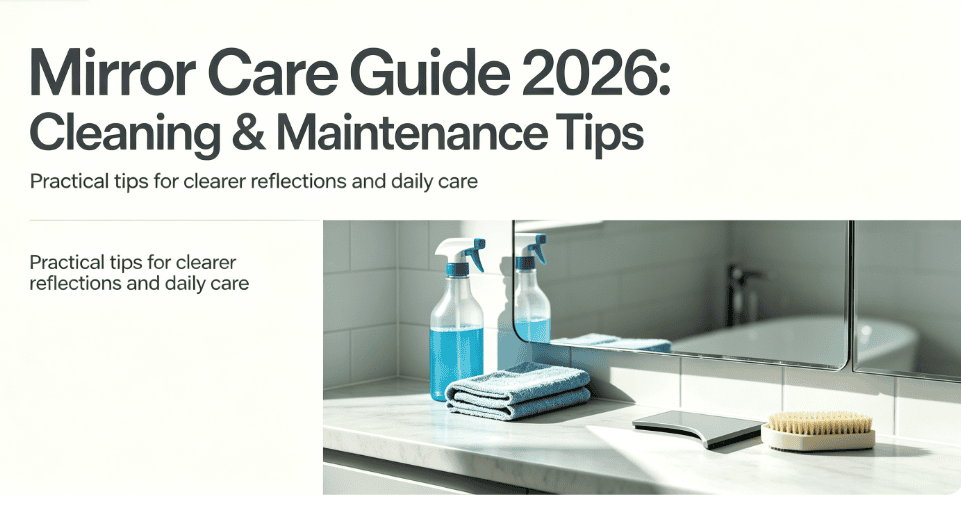
How to Clean a Mirror Without Damaging the Coating
- Use a microfiber cloth with a mild, alcohol-free glass cleaner. Avoid ammonia-heavy sprays that break down the silver layer over time.
- Never spray liquid directly onto the glass. Mist the cloth instead, then wipe in straight vertical or circular strokes to avoid streaks.
- Keep liquids away from the edges and frame seams — that is where moisture seeps in and starts black spots.
Cleaning Products That Quietly Ruin Mirrors
The cleaners that damage mirrors are usually the ones sold as heavy-duty. Ammonia-based glass sprays attack the protective paint at the edges over repeated use. Acidic household staples — white vinegar, lemon juice, descaler — etch the silver film, and the damage surfaces weeks later as a dull patch that will not come clean. Cream cleansers and melamine sponges are abrasive enough to cut through the surface in a single pass.
Hard water is the other slow failure. Mineral deposits left to dry on the glass bond to the surface and push the owner into scrubbing harder, which is where scratching begins. In hard-water areas, dry the mirror after use with a dedicated cloth rather than waiting for spots to form, and reach for a chelated water-softening cleaner instead of an acid descaler.
For hotel and gym housekeeping teams the practical control is a labelled cloth system: one colour for mirrors and glass with an approved alcohol-free cleaner, a separate colour for everything else. Most mirror damage in commercial settings starts with someone reaching for the wrong bottle.
How to Keep a Bathroom Mirror From Fogging
The reliable fix is a certified anti-fog heated film with an automatic cutoff, rated for bathroom use. A genuine bathroom mirror manufacturer builds the heating layer in-house and runs an aging test, so fog-free performance holds after installation. Cheap stick-on pads fade within a season.
Preventing Scratches and Edge Damage
- Mount with anti-shatter backing film — critical for bathrooms and gyms.
- Avoid abrasive pads and rough hardware near the surface.
- For frameless models, protect the polished edge during handling and transport.
Why Mirrors Go Black at the Edges
Almost every mirror that fails in service fails at the edge, not in the middle of the glass. The reflective layer is a thin silver film protected by copper and paint, and the cut edge is the one place where it is exposed. Moisture wicks into that edge, reaches the silver, and oxidises it into the dark blotchy desilvering that customers report as a defect. Once it starts it cannot be polished out.
That is why edge protection is a specification item rather than a cosmetic one. A sealed or painted edge, a bevel that keeps standing water off the laminate, and a backing film that stops condensation sitting against the rear face all extend service life far more than any cleaning habit. In bathrooms and gyms — the two most humid settings — the back of the mirror matters as much as the front, which is why sealing the perimeter at installation is worth the extra few minutes.
If a batch arrives with cloudy edges, or with visible white bloom under the paint, reject it before installation. Edge corrosion present at delivery will spread, and it will show up in the customer’s bathroom within a season rather than in your incoming inspection.
LED Mirror Maintenance
- Choose a branded constant-current driver — it is the #1 factor in LED lifespan (30,000–50,000 hrs).
- Keep the driver cavity ventilated; heat is what kills strips early.
- If a section flickers, it is usually the driver, not the LEDs — a quality unit is field-replaceable.
For bathroom safety ratings, verify the mirror has an IP rating tested by a certified lab.
Storage and Moving Tips
Store mirrors vertically, never flat, with corner protectors and a 3-layer foam wrap. Standing them against a wall at an angle invites cracks. For bulk shipments, see our sustainable packaging approach.
Buying the Right Mirror Saves Maintenance
Most mirror failures trace back to the spec, not the cleaning. If you buy for resale, hotels, salons, or a private-label line, work with a factory that controls silvering, anti-fog, and driver assembly in-house — like a dedicated LED mirror manufacturer in China. Correct IP rating and certified components up front mean near-zero maintenance later.
Need Mirrors for Your Project? Get a Manufacturer Quote
- 📩 Request a quote → Contact form
- 💬 WhatsApp: [+86 15731966651] | WeChat: [18731933711]
- 🏭 Certified OEM/ODM — CE / UL / RoHS — MOQ from 50 pcs
Send your size, function set, and target market — quote within 24 hours.
Mirror Care Guide Checklist for Bulk Buyers
If you are ordering mirrors for hotels, salons, or resale, add this mirror care guide checklist to your sourcing notes:
- Request a copper-free silver mirror with anti-shatter backing for durability.
- Confirm LED drivers are branded and aging-tested to avoid flickering returns.
- Choose anti-fog heating films with auto cutoff, not stick-on pads.
- Verify IP44 or higher rating for bathroom placement.
- Pack and store mirrors vertically with corner protection during transport.
Sharing these points with your supplier during the PO stage reduces defects, returns, and long-term maintenance costs.
Maintenance Schedule by Environment
Cleaning frequency should follow humidity and traffic rather than a fixed calendar. The intervals below are the ones most buyers settle on after their first year of operation.
| Environment | Cleaning | Inspect | Watch for |
|---|---|---|---|
| Home bathroom | Weekly | Quarterly | Edge bloom; fogging that outlasts the anti-fog film |
| Hotel bathroom | Daily wipe, deep clean weekly | Monthly | Sealant failure at the perimeter; desilvering at the base |
| Gym and fitness studio | Daily | Monthly | Sweat residue; impact damage; loose mounting |
| Salon station | Daily, between clients | Quarterly | Chemical overspray from hair products; strip dimming |
| Retail display | Weekly | On reset | Fingerprints on bevels; cable and driver strain |
The inspection column matters more than the cleaning column. A defect caught at a scheduled inspection is usually a re-seal; the same defect caught after failure is a replacement.
How to Choose Low-Maintenance Mirrors
Choosing the right mirror from the start reduces almost all maintenance. Look for a certified supplier that controls silvering, LED driver assembly, and anti-fog testing in-house. A true LED mirror manufacturer can share aging-test reports, IP certificates, and OEM options so your bulk order stays trouble-free for years.
Frequently Asked Questions
How do I keep a bathroom mirror from fogging?
Choose a mirror with a certified anti-fog heated film and at least IP44 rating for bathroom use. A genuine bathroom mirror manufacturer builds the heating layer in-house and runs an aging test so fog-free performance holds after installation.
What is the safest way to clean a mirror without damaging the coating?
Use a microfiber cloth with a mild, alcohol-free glass cleaner. Avoid spraying liquid directly on edges or onto the mirror surface, and never use abrasive pads that can scratch the silver backing.
How long does a quality LED mirror last?
With a branded constant-current driver and a 48–72h aging test, a quality LED mirror typically delivers 30,000–50,000 hours of service life. Cheap drivers without aging are the main cause of early flickering failures.
Can I get custom-sized mirrors from a Chinese manufacturer?
Yes. Most specialized factories offer OEM/ODM: custom sizes, shapes (round, arched, pill, frameless), frame materials, anti-fog films, and branded packaging. Provide drawings or reference images; engineering support usually starts from the prototype stage.
What certifications should a bathroom mirror have?
For the US and Canada you need UL or ETL listing; for the EU you need CE (LVD + EMC) and RoHS/REACH; for the UK, UKCA. Bathroom placement requires an appropriate IP rating (IP44+). Confirm valid certificates issued to the actual manufacturer.
Conclusion
A good mirror care guide protects your investment, but the smartest maintenance happens at the spec stage. Choose certified, factory-direct mirrors and most of these steps become routine rather than repairs.

