
Looking for a frameless wall mirror supplier? WOSEN is a full-range mirror factory producing beveled and polished frameless wall mirrors, with custom sizes, samples in 5-7 days and export-grade breakage-safe packing. Below is the 2026 vetting checklist buyers use.
If you are sourcing frameless wall mirrors for a hotel program, a retail brand, or an Amazon FBA line, the frame is the easy part of the decision — there isn’t one. The entire quality of a frameless mirror sits in three things you cannot see on a photo: the edge finish, the silvering, and the packaging. This guide breaks down how to evaluate a frameless mirror supplier in China before you send a purchase order, based on the checks a full-range factory like ours applies to every panel.
Why Frameless Mirrors Win on Margin and Style
Frameless (edgeless) mirrors are the default choice in modern bathrooms, hotel corridors, and retail fit-outs for two reasons:
- No style conflict. A clean beveled or polished panel works with any interior scheme, which makes one SKU valid across many room types or stores.
- Lower unit cost. With no frame material or frame assembly, frameless panels carry the highest margin per unit of any mirror format for most B2B buyers.
The trade-off: with no frame to hide defects, every quality shortcut shows. That is exactly why the supplier you choose matters more for frameless than for any other mirror category.
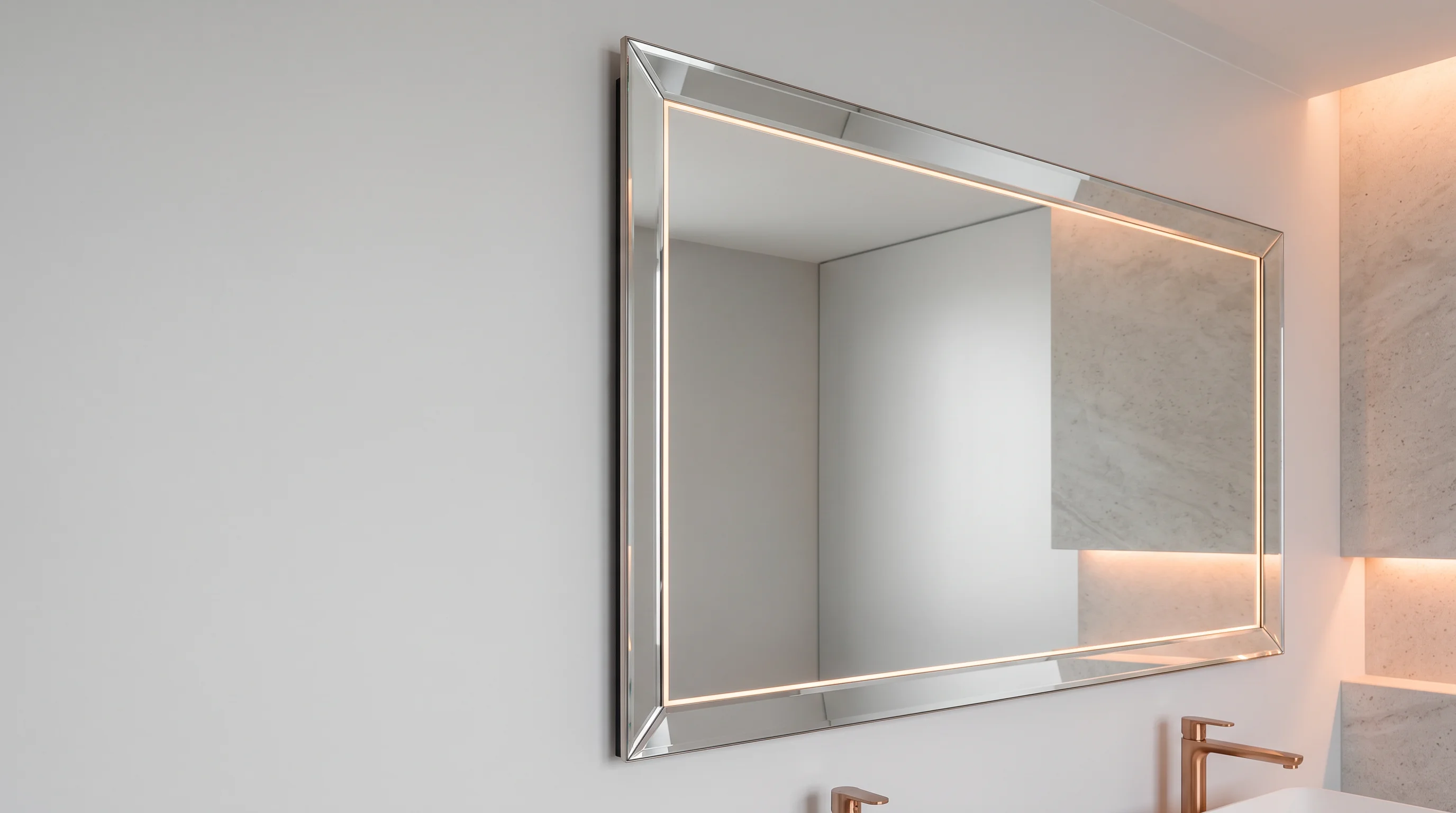
The 3 Decisions That Define Your Frameless Line
1. Edge finish: polished vs beveled
These are the two standard frameless edge treatments:
- Polished flat edge — ground and polished smooth with a straight profile. The sharp, modern look; the default for minimalist bathrooms and corporate fit-outs.
- Beveled edge — cut at an angle (commonly a 1-inch bevel) so the edge catches light and adds visual depth. The classic “gallery” look, popular in hotels and vanity settings.
A capable factory produces both to consistent angle and tolerance on the same line, and matches whichever your design drawings specify. If a supplier offers only one edge treatment, ask directly before ordering.
2. Glass: float, copper-free silver, tempered
Base glass for most frameless panels is 5mm float glass with a copper-free silver coating and anti-corrosion backing — the combination that resists the greenish edge corrosion you sometimes see on cheaper silvering after months of humidity. For gyms, studios, and high-traffic commercial areas, specify tempered glass: it offers significantly higher impact resistance, and most hotel and fitness specifications require it for large panels.
3. Size and format
Frameless is cut-to-size by nature: round panels from 30cm up to large rectangular formats, plus half-round, arched, and irregular shapes. Confirm your maximum panel size against the supplier’s in-house cutting capability — large panels cut and edged in the same factory are far less likely to arrive chipped than panels that were cut, shipped, and re-edged by a middleman.
How to Vet a Frameless Mirror Supplier: 7 Checks
Use this checklist on any Chinese frameless mirror supplier, trader or factory:
- In-house edge line? Ask where the edge polishing or beveling happens. A factory with its own cutting, silvering, and edge-finishing lines controls the step that defines frameless quality. A trader re-packs panels cut elsewhere — you will know within one container.
- Edge consistency across a batch. Request sample photos of the edge at 45° under light. Bevel angle should be uniform along the full length of each edge; polished edges should show no grind marks or chips. This is the single most telling test.
- Silvering inspection. Ask how the factory inspects for silvering defects (spots, lines, adhesion). Look for a multi-step inspection process rather than “visual check only”.
- Tempering capability. If your spec includes tempered glass, confirm whether tempering and re-edging are done in-house and how the factory verifies temper quality.
- Packaging engineering. Frameless panels break at the edges — the edges are the weak point in transit. Ask to see the packaging: dedicated edge protectors and corner guards, vertical packing, palletized. A factory that produces its own seaworthy export packaging for edge-vulnerable formats is doing real breakage engineering, not just cartons.
- Certifications for your market. For the EU/UK: CE and RoHS are the baseline to ask for. For the US: UL and ETL can usually be arranged on request for LED versions — ask for the timeline and cost before you commit. ISO 9001 is the standard factory-level quality system certificate.
- Sample policy. A serious supplier will produce samples to your exact edge and glass spec in about a week and will say clearly how sample fees are handled against a bulk order. If sampling is vague, walk away.

What to Put in Your PO (Specification Template)
Send these fields and you will get comparable quotes from any serious supplier:
- Format: round / rectangular / arched / irregular — with exact dimensions in mm
- Edge: polished flat or beveled (state bevel width, e.g. 1-inch)
- Glass: thickness (typically 5mm), float/copper-free silver, tempered yes/no
- Coating options: anti-fog (bathroom), LED with color temperature if lighted
- Hardware: e.g. Z-bar mounting (confirm it is included)
- Packaging: export seaworthy, edge-protected; carton marking per your brand
- Certification required for destination market
- Quantity and target price point
A supplier that can answer all of these within 72 hours, including lead time in writing, is a supplier you can plan a project around.
Lead Times and Cost Drivers
Typical timeline with a direct factory: samples in 5–7 days, bulk production in 15–35 days after order confirmation, depending on quantity and specification. What moves the price: panel size (larger = more glass handling and packaging cost), edge treatment, tempering, anti-fog or LED options, and order quantity. There is no published “price per mirror” for frameless — two buyers with the same nominal size can get different quotes if their edge, glass, and packaging specs differ. Get quotes against the same written spec to compare fairly.
Shipping Frameless: Where Breakage Actually Happens
Most frameless breakage claims trace back to three causes: horizontal packing (panels stacked flat under their own weight), unprotected edges, and mixed loading with hard goods. A factory that packs vertically with dedicated edge and corner protection, palletizes, and shares packing photos before loading will produce a dramatically different arrival rate than one that ships panels in generic cartons. Before you load, ask for the packing photos — it takes them two minutes and tells you everything.
Why Source Frameless From a Full-Range Factory
Frameless panels rarely ship alone. Hotel programs mix frameless bathroom mirrors with framed lobby pieces, standing mirrors, and LED units; retail brands mix frameless with salon or gym formats. A full-range factory lets you consolidate all of it under one PO, one quality standard, and one container — which is where the real freight savings are. See our OEM/ODM mirror solutions page for how mixed programs are structured, or the mirror factory selection guide for the full vetting framework.
FAQ
What should I look for first when choosing a frameless mirror supplier?
Edge finishing capability. The edge is the entire quality story of a frameless mirror — ask where cutting, silvering, and edge finishing happen, and request 45° edge photos of a production batch before you commit to a container.
Is beveled edge better than polished edge?
It depends on the interior style, not quality. Beveled edges catch light and read as classic/gallery; polished edges read as sharp/modern. A proper factory produces both to your spec — choose by design, and verify consistency on samples either way.
How thick should frameless bathroom mirrors be?
5mm float glass is the standard for most wall-mounted frameless panels. If your spec is for large formats or high-traffic areas, ask about tempered options — impact resistance increases substantially.
How do I compare quotes from different frameless mirror factories?
Quote against the same written specification — size, edge treatment, glass type and coating, tempering, hardware, and packaging. Two “identical” frameless mirrors with different edge or packaging specs are not the same product, and their prices won’t be comparable otherwise.
What certifications should a frameless mirror supplier have for the EU and US markets?
For EU/UK, CE and RoHS are the baseline for the glass product itself, with ISO 9001 as the factory quality system. For US LED versions, UL and ETL can typically be arranged on request — confirm timeline and cost before committing. Note: certifications for LED versions cover the electrical assembly, not just the mirror.
What is the typical lead time for frameless mirrors from China?
Samples in 5–7 days; bulk production in 15–35 days after order confirmation, depending on quantity and specification. Reputable suppliers confirm the lead time in writing with the quotation.
Ready to specify your frameless line? Send us your drawings or a reference sample — our engineering team replies within 72 hours with feasibility, MOQ, and pricing. Explore the current range on the frameless mirror page.

