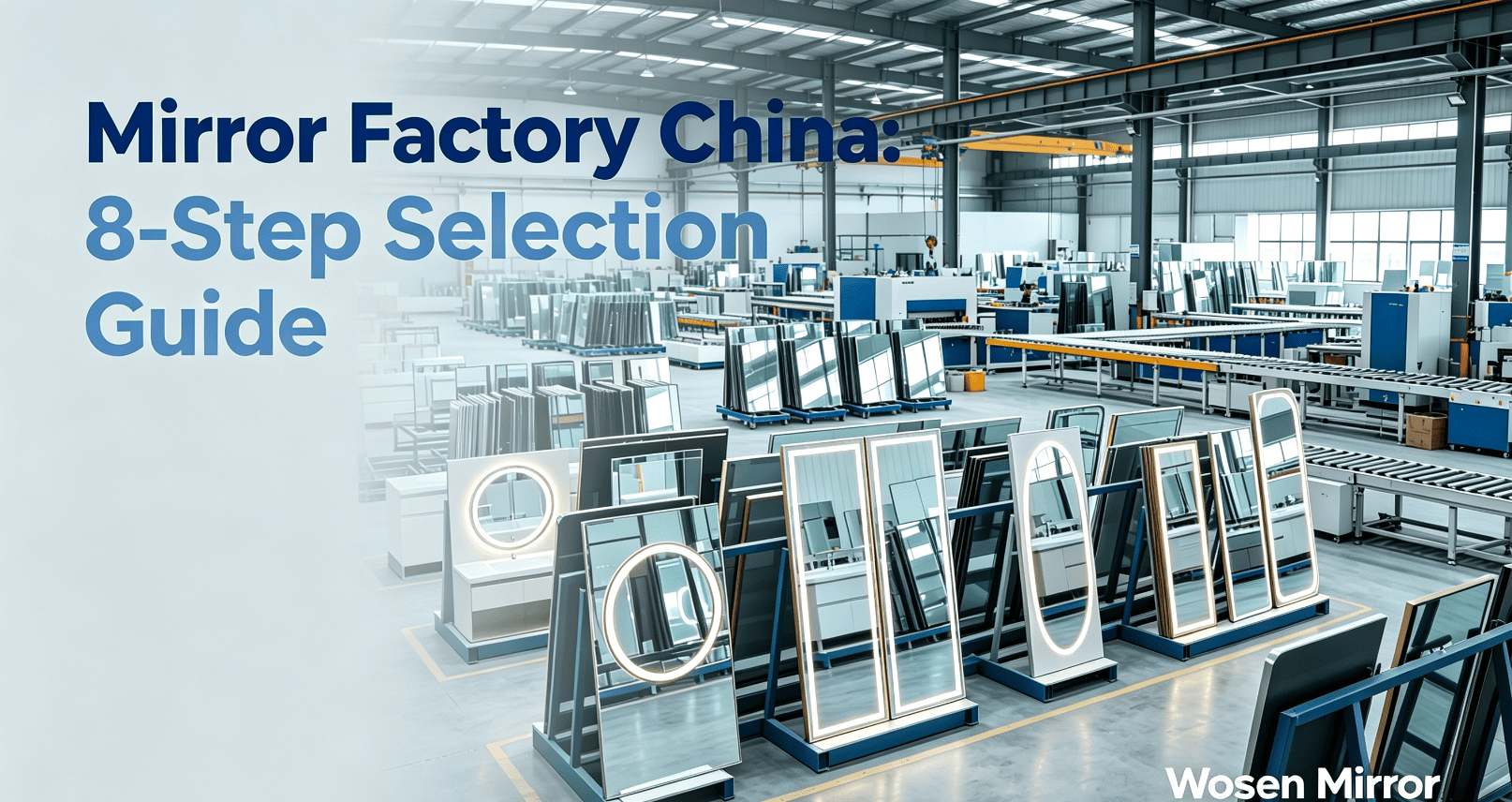
Choosing the right mirror factory China can make or break your sourcing success. The country’s mirror manufacturing industry is concentrated in Guangdong,Hebei, Zhejiang, and Fujian provinces, where thousands of factories produce everything from basic vanity mirrors to LED smart mirrors for global brands. For an importer, the question is not whether to source from a mirror factory in China — it is how to identify the right one among thousands of options, many of which look identical on a supplier directory page.
This guide gives you a practical, step-by-step framework for evaluating any mirror factory China has available. Each factor is drawn from real sourcing experience — things that go wrong when buyers skip due diligence, and things that go right when they ask the right questions before placing an order.
Why Choosing the Right Mirror Factory China Partner Matters
A mirror is deceptively simple. It is a sheet of glass with a reflective coating and, in many cases, integrated LED lighting and electronics. But the difference between a mirror that arrives at your warehouse with edge chips, uneven silvering, and failed LED drivers — and one that arrives in perfect condition, ready to sell — comes down entirely to the factory that made it.
The cost of choosing the wrong mirror factory in China goes beyond a single shipment. Returns and warranty claims from your customers damage your brand reputation. Delays from factories that overpromise on production capacity disrupt your sales pipeline. Quality inconsistencies between batches force you to inspect every shipment — eating into margins that a reliable factory would have preserved. Selecting the right factory is the single highest-leverage decision in your mirror sourcing strategy.
Related Guide: Once you have identified a factory, our comprehensive guide to importing mirrors from China covers the full logistics chain — from quality inspection and shipping to customs clearance and post-delivery support.
8 Factors to Evaluate When Selecting a Mirror Factory China Supplier
1. Manufacturing Specialization
Not all mirror factories are the same. A factory that produces basic float glass mirrors for furniture is not equipped to manufacture IP44-rated LED bathroom mirrors with anti-fog pads and touch sensors. Ask the factory what mirror categories they specialize in and what percentage of their annual output each category represents. A factory that produces 80% LED bathroom mirrors and 20% decorative wall mirrors has very different expertise and equipment from one that produces 90% furniture mirrors and occasionally runs a batch of LED products.
Key questions to ask:
- What mirror types represent your top three revenue categories?
- Do you manufacture the LED drivers and electronic components in-house, or do you outsource them?
- Can you provide production line photos or videos specific to the mirror type I need?
Specialization matters because mirror manufacturing involves multiple processes — glass cutting and edging, silvering or aluminum coating, frame fabrication, LED integration, and quality testing. A factory that does all of these daily for your exact product category will consistently outperform a generalist that occasionally takes on similar orders.
2. Quality Certifications
Certifications are the most objective way to filter a mirror factory in China. For mirror products sold in Western markets, the baseline certifications are:
- CE (European Union): Required for mirrors with electrical components (LED mirrors). Covers electromagnetic compatibility and low-voltage safety directives.
- UL / ETL (North America): Required for LED mirrors entering the US and Canadian markets. UL 962 covers household and commercial furnishings. ETL is an equivalent mark accepted by North American retailers.
- ISO 9001: Quality management system certification. Indicates the factory has documented and audited processes for production, quality control, and continuous improvement. For details on ISO 9001 requirements, ISO publishes the full standard and certification framework.
- IP Rating (for bathroom mirrors): An IP44 or IP65 rating certifies that the mirror’s electrical components are protected against moisture and water splashes — essential for bathroom environments.
- RoHS / REACH: Restriction of hazardous substances. Required for EU market access and increasingly requested by North American retailers.
Action item: Ask the factory to send you copies of their current certifications. Check the expiry dates — certifications require annual renewal. A factory that lets them lapse is a red flag. If you have any doubts, verify directly with the certifying body’s public database.
3. Production Capacity and Lead Times
A mirror factory’s stated capacity means nothing without context. A factory may claim a capacity of 50,000 mirrors per month, but that tells you nothing about how much of that capacity is already committed to existing clients. What matters is their available capacity for your order volume and their track record of meeting delivery deadlines.
Request concrete data:
- What is your current monthly output, and what percentage is uncommitted?
- For an order of [your typical volume], what is your standard production lead time from deposit to ex-works?
- Can you share your on-time delivery rate for the past 12 months?
- During peak season (typically August-November for holiday retail orders), how much does lead time extend?
A good mirror factory in China should provide specific answers. Vague responses like “don’t worry, we can handle your order” without numbers indicate either disorganization or intentional ambiguity — both are risks you do not want in your supply chain.
4. Minimum Order Quantity (MOQ)
MOQ is one of the most practical filters when shortlisting mirror factories. A factory with an MOQ of 500 units per design is targeting mid-to-large importers and brands. A factory with an MOQ of 50 units is more flexible but typically operates at a smaller scale with less sophisticated quality systems.
The MOQ you encounter depends on the mirror type:
- Standard bathroom mirrors (non-LED): MOQ often ranges from 50–200 units per design.
- LED bathroom mirrors: MOQ typically starts at 100–300 units due to the electronic component supply chain.
- Custom-designed mirrors (OEM): MOQ is generally 200–500 units per design, reflecting the mold, tooling, and setup costs involved.
- Hotel project mirrors: MOQ can range from 50–500 depending on standardization; custom hotel mirrors with specific dimensions and finishes command higher minimums.
Be suspicious of MOQs that are dramatically lower than the market average for that product category — it often signals that the factory is a trading company, not a manufacturer, and is aggregating orders from multiple small workshops with inconsistent quality.
5. Customization and OEM/ODM Capability
If you are building a brand rather than just reselling generic mirrors, OEM and ODM capability is non-negotiable. Evaluate the factory’s customization depth across these dimensions:
- Glass customization: Can they produce mirrors in non-standard shapes (arched, round, irregular) and thicknesses (3mm, 4mm, 5mm, 6mm)? Do they offer copper-free silver mirrors for high-humidity environments?
- Frame and finish: Do they manufacture frames in-house (aluminum, stainless steel, wood) or outsource? What surface finishes are available — brushed, polished, powder-coated, anodized?
- LED integration: Can they customize color temperature (3000K warm to 6500K daylight), CRI (standard 80 vs. high 90+), LED placement (backlit, front-lit, edge-lit), and driver specifications?
- Branding: Do they support private labeling — logo engraving, branded packaging, custom user manuals, and labeling compliant with your target market regulations?
- Design support: Does the factory have an in-house design team that can translate your concept into production-ready specifications, or do you need to provide fully detailed technical drawings?
A factory that does all customization in-house has tighter quality control than one that outsources components. For example, a mirror factory that fabricates its own aluminum frames can guarantee frame-to-glass fit tolerances far better than one that orders frames from a third-party metal shop.
Internal Link: Learn more about custom mirror development in our guide on custom mirror solutions for bathroom, hotel, and commercial projects.
6. Quality Control Process
A factory’s quality control process separates professional manufacturers from workshops. Request a detailed breakdown of their QC workflow, which should include at minimum:
- Incoming material inspection: Glass sheets inspected for bubbles, scratches, and thickness consistency before cutting. LED strips tested for color temperature uniformity and lumen output before installation.
- In-process inspection: Edge grinding quality, silvering uniformity, frame assembly precision — checked at each stage, not just at the end.
- Finished product testing: Every LED mirror should undergo at minimum a 4-hour burn-in test. Mirrors should be checked for reflection distortion, edge defects, and electrical safety.
- Pre-shipment inspection: AQL (Acceptable Quality Limit) sampling per international standards. The factory should have documented AQL levels for critical, major, and minor defects.
If the factory cannot describe their QC process in detail and provide QC checklists, inspection reports, or defect-rate statistics, treat that as a red flag. Quality that is not measured and documented is quality that does not exist.
7. Communication and After-Sales Support
Communication quality is one of the most underrated factors in mirror factory selection. A factory that responds within 24 hours with clear, specific answers — rather than vague reassurances — saves you weeks of back-and-forth over the lifetime of your partnership.
Evaluate during your initial interactions:
- Does the sales contact understand technical mirror specifications, or do they need to “check with the factory” for every question?
- Are their English communication skills sufficient for discussing complex customization requirements and quality issues?
- Do they proactively share production updates, or do you need to chase them for status reports?
After-sales support is equally critical. Confirm the warranty terms before placing an order: What is the warranty period (typically 2-5 years for LED mirrors)? What is the defect replacement policy? Who covers shipping for warranty replacements? A factory that offers a 5-year warranty but takes weeks to process claims is no better than one with a 1-year warranty and prompt support.
8. Factory Audit and Site Visit
A factory audit is the ultimate validation step. While photos and video calls provide useful signals, they cannot replace a physical site visit or a third-party audit. For importers unable to visit in person — which is common for first-time buyers — third-party inspection companies like SGS offer factory audit services that cover production capability, quality management systems, social compliance, and security.
During a site visit or audit, focus on:
- Production environment: Is the factory floor organized, clean, and well-lit? Mirror production requires a dust-controlled environment — dust on glass surfaces during silvering creates visible defects.
- Equipment condition: Are cutting, edging, and coating machines well-maintained? Worn cutting wheels produce chipped edges. Aging silvering lines produce uneven coating.
- Worker conditions: Do workers wear appropriate safety equipment? Are working hours reasonable? Ethical compliance matters directly to Western retail buyers and import regulations.
- Sample consistency: Compare the sample you received with the production line output. Does the production line product match the sample quality?
Red Flags That Should Make You Walk Away
Some warning signs are universal across any mirror factory in China:
- Unwillingness to share certifications: If a factory claims to have CE or UL certification but cannot or will not share the certificate documents, they do not have valid certifications.
- Prices far below market average: A mirror that costs 30% less than every other quote is cutting corners somewhere — thinner glass, cheaper silvering, uncertified LED drivers, or all three.
- No physical factory address: Some supplier directory listings are actually trading companies pretending to be factories. Ask for the factory’s physical address and verify it on a map. If they refuse or hedge, they are a middleman.
- No reference clients: A factory that has been operating for years should have reference clients they can name, even if specific project details are confidential. A complete inability to provide any references is suspicious.
Sourcing From a Mirror Factory China Exporter Like Wosen Mirror
At Wosen Mirror, we have spent years building a mirror manufacturing operation designed specifically for international buyers. Our factory in the HeBei mirror manufacturing cluster produces LED bathroom mirrors, wall-mounted mirrors, floor mirrors, makeup vanity mirrors, and custom commercial mirrors for brands, hotel chains, and retailers across North America, Europe, the Middle East, and Southeast Asia.
What sets our factory apart for importers:
- Full certifications: CE, UL, ETL, ISO 9001, RoHS, and REACH compliance across our product lines. Certification documents are available for review before your first order.
- In-house production: Glass cutting and edging, silvering, LED driver assembly, aluminum frame fabrication, and packaging are all done under one roof — no outsourced components, no quality gaps between suppliers.
- Custom OEM/ODM: From private-label branding and custom packaging to fully custom mirror designs with your specifications for size, shape, lighting, and smart features. Our in-house design team converts your concept into production-ready drawings.
- Flexible MOQ: Standard models are confirmed per order; custom designs are quoted per project. For hotel projects, we work with you to structure MOQs that match your phased rollout plan.
- QC you can verify: Every LED mirror undergoes a 4-hour burn-in test. We provide pre-shipment inspection reports with your shipment. Third-party inspection by SGS, Bureau Veritas, or your nominated inspector is always welcome.
If you are sourcing a mirror factory in China and want to work with a manufacturer that communicates clearly, delivers on time, and stands behind product quality, contact our export team with your requirements. We will respond within 24 hours with a detailed quote, production timeline, and answers to every question on your due diligence checklist.
Browse Products: Explore our LED mirror collection — featuring backlit, front-lit, dimmable, anti-fog, and smart mirror models for residential and commercial markets worldwide.

