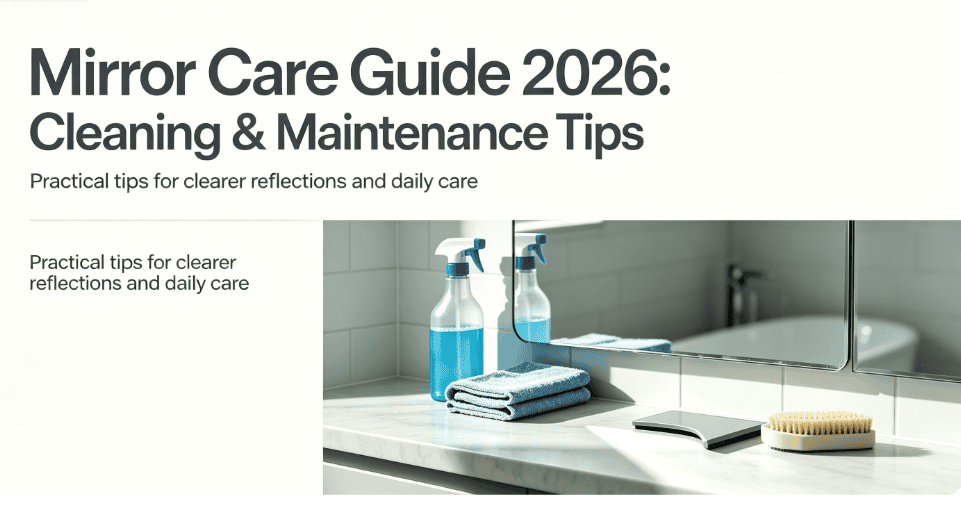
This mirror care guide covers cleaning techniques, LED mirror maintenance, desilvering prevention, and long-term care schedules for homes, hotels, and commercial properties.
A mirror is one of those household items you use every single day but rarely think about maintaining — until streaks, black edges, or fogging make it impossible to see your reflection clearly. Proper mirror care is not complicated, but most people clean their mirrors incorrectly, using products and techniques that slowly degrade the reflective surface and shorten the mirror’s lifespan by years.
This mirror care guide covers everything you need to know about keeping your mirrors spotless, streak-free, and structurally sound in 2026. We walk through the right cleaning tools, step-by-step techniques for every mirror type, common damage prevention, and long-term maintenance strategies that protect your investment whether you own a single bathroom mirror or manage mirrors across an entire hotel property.

Why Mirror Care Matters More Than You Think
The Hidden Cost of Poor Mirror Maintenance
A quality mirror lasts 15 to 20 years with proper mirror care. Without it, that same mirror may show visible degradation within 5 years. The most common damage — black edges, cloudy patches, silver backing deterioration — is almost always caused by improper cleaning habits, not manufacturing defects. When moisture penetrates the protective backing behind the glass, the silver layer oxidizes and turns black. Once this process starts, it cannot be reversed. The only solution is replacement, which is far more expensive than the mirror care practices that would have prevented it.
For commercial property owners managing dozens or hundreds of mirrors, the cost difference is even more dramatic. A hotel with 200 bathroom mirrors that last 15 years instead of 5 saves tens of thousands of dollars in replacement costs, labor, and guest complaints — all from consistent mirror care protocols.
What Actually Damages a Mirror Over Time
Understanding what destroys mirrors is the foundation of effective mirror care. The four primary culprits are:
- Moisture penetration: Water that seeps behind the frame or through edge sealant reaches the silver backing and causes oxidation — the black edge problem.
- Ammonia-based cleaners: Common glass cleaners containing ammonia slowly dissolve the protective paint layer on the back of the mirror, accelerating silver degradation.
- Abrasive materials: Paper towels, newspaper, and rough cloths create micro-scratches on the glass surface that accumulate over time, leaving mirrors permanently cloudy.
- Humidity and temperature swings: Bathrooms with poor ventilation create condensation that settles along the bottom edge of the mirror — the most vulnerable point for moisture damage.
Internal Link: If your mirrors are already damaged beyond cleaning, it may be time for replacement. Start with our wall mounted mirror buying guide to choose a durable replacement built to last.
Mirror Care Guide: Essential Tools and Supplies
The right tools make mirror care faster, more effective, and safer for your mirrors. Here is exactly what you need — and what you should never use.
What You Need
| Tool | Purpose | Why It Matters |
|---|---|---|
| Microfiber cloths | Wiping and polishing | Lint-free, non-abrasive, reusable — the single most important mirror care tool |
| Distilled water | Cleaning solution base | Free of minerals that cause streaks and spots, unlike tap water |
| White vinegar | Natural cleaning agent | Dissolves grease and hard water spots without damaging the silver backing |
| Isopropyl alcohol (70%) | Stubborn stain removal | Evaporates quickly, safe for glass, removes adhesive residue and toothpaste splatter |
| Squeegee (small) | Large mirror cleaning | Removes cleaning solution in one pass, preventing streaks on oversized mirrors |
| Soft-bristle brush | Frame and edge cleaning | Removes dust from frame grooves without scratching glass |
What to Avoid at All Costs
- Ammonia-based glass cleaners (Windex and similar): The ammonia degrades mirror backing over time. Fine for windows, risky for mirrors.
- Paper towels and newspaper: Both leave lint and create micro-scratches. Paper towels also absorb cleaning solution unevenly, causing streaks.
- Abrasive sponges and scouring pads: These permanently scratch glass. There is no way to polish scratches out of a mirror.
- Excessive liquid: Spraying cleaner directly onto the mirror causes runoff that pools at the bottom edge and seeps behind the frame — the number one cause of desilvering.
For authoritative guidance on safe cleaning practices for glass surfaces in residential and commercial settings, The Spruce publishes extensively tested home care recommendations reviewed by cleaning professionals.
How to Clean Mirrors: Step-by-Step Mirror Care
Follow this mirror care sequence every time you clean. It takes less than 5 minutes per mirror and produces a streak-free result that lasts.
Step 1: Remove Loose Dust First
Before applying any liquid, use a dry microfiber cloth or soft brush to remove dust from the mirror surface and frame edges. Skipping this step means you will drag dust particles across the glass when you wipe, creating micro-scratches. For framed mirrors, run a soft-bristle brush along the inner frame edge where dust accumulates — this is a critical mirror care step that most people overlook.
Step 2: Apply Cleaner to the Cloth, Not the Mirror
This is the single most important mirror care rule: never spray cleaning solution directly onto the mirror. Always apply it to your microfiber cloth first, then wipe. This prevents liquid from running down the glass and pooling at the bottom edge where it can penetrate behind the frame and damage the silver backing.
For the cleaning solution, mix equal parts distilled water and white vinegar in a spray bottle. This combination cuts through grease, toothpaste splatter, and hard water spots without any of the damaging effects of commercial ammonia cleaners. For stubborn stains like dried toothpaste or hairspray, dab isopropyl alcohol directly onto the spot with a cloth and let it sit for 30 seconds before wiping.
Step 3: Wipe in a Systematic Pattern
Wipe the mirror using a top-to-bottom, then side-to-side pattern — not circular motions. Circular wiping redistributes dirt and cleaning solution rather than removing it, and it tends to leave streaks. Start from the top left corner and work across in horizontal strokes, then move down to the next row. This ensures every inch of the surface is covered systematically.
Step 4: Buff Dry with a Clean Cloth
Use a second dry microfiber cloth to buff the mirror immediately after wiping. This removes any remaining moisture and eliminates streaks. Buff in straight lines, not circles, and use firm but gentle pressure. If streaks persist, slightly dampen the buffing cloth with distilled water and go over the surface again.
Step 5: Clean the Frame and Edges
Proper mirror care includes the frame, not just the glass. Wipe wooden frames with a barely damp cloth and dry immediately. For metal frames, use a dry microfiber cloth to remove dust and fingerprints. Pay special attention to the bottom edge of the frame where moisture and dust collect — this area is the front line of mirror care defense against desilvering.
Internal Link: A properly installed mirror is easier to maintain. Follow our mirror installation guide to ensure your mirrors are mounted with adequate ventilation and edge protection from the start.
Mirror Care by Type: Specific Maintenance Tips
Different mirror types require different mirror care approaches. What works for a simple frameless bathroom mirror can damage an LED mirror or an antique.
LED and Lighted Mirrors
LED mirrors need mirror care that protects both the glass and the electrical components. Never spray any liquid near the LED strip housing, touch sensor, or power connection points. Clean the glass area only, using a cloth dampened with vinegar solution. For the LED strip itself, use a dry microfiber cloth or a can of compressed air to remove dust — never liquid. Check the power cable and connection point every few months for signs of moisture or corrosion, especially in bathroom installations.
If your LED mirror has an anti-fog feature, test it monthly to ensure the heating pad is functioning. A failed anti-fog pad allows condensation to sit on the mirror surface longer, increasing the risk of moisture damage to the backing.
Frameless Mirrors
Frameless mirrors have exposed edges that are highly vulnerable to moisture. Mirror care for frameless mirrors should include inspecting the edge sealant every 6 months. If you see gaps, cracks, or peeling in the edge sealant, apply a new bead of neutral-cure silicone sealant around the entire perimeter. This single step can add years to a frameless mirror’s lifespan by preventing the moisture penetration that causes desilvering.
Antique and Decorative Mirrors
Antique mirrors require the gentlest mirror care of all. The silvering on antique mirrors is often fragile and already partially degraded. Never use vinegar, alcohol, or any liquid cleaner on an antique mirror. Instead, use a dry, ultra-soft microfiber cloth or a soft makeup brush to gently remove dust. If the glass is cloudy, consult a professional mirror restorer — attempting to clean antique mirror glass yourself can cause irreversible damage to the already fragile silver layer.
Preventing Common Mirror Problems
Black Edge Desilvering
Black edges are the most common and most preventable mirror problem. They occur when moisture reaches the silver backing and causes oxidation. Mirror care prevention strategies:
- Always apply cleaner to the cloth, never the mirror surface.
- Ensure bathroom mirrors have at least 2mm gap between the mirror bottom edge and the countertop to prevent water wicking upward.
- Improve bathroom ventilation with an exhaust fan to reduce condensation.
- Re-seal frameless mirror edges annually with neutral-cure silicone.
Once desilvering begins, it cannot be reversed. The damaged area will slowly expand over time. For guidance on glass and mirror quality standards, consult ASTM International specifications on silvered flat glass durability and testing.
Scratches and Chips
Scratches are permanent — there is no mirror care technique that removes them. Prevention is everything. Keep jewelry, watches, and hard objects away from mirror surfaces during cleaning. Never use the mirror as a backing surface for applying makeup or styling hair, as accidental contact with tools causes chips along the edges.
Fogging and Condensation
Bathroom mirrors fog up because warm moist air condenses on the cooler glass surface. While fogging itself does not damage the mirror, the water droplets that run down the glass can contribute to edge moisture problems. Mirror care solutions for fogging include installing an anti-fog mirror with a built-in heating pad, applying a commercial anti-fog spray monthly, or rubbing a small amount of shaving foam on the glass and buffing it off — a temporary DIY anti-fog trick that lasts several days.
Long-Term Mirror Care: Extend Your Mirror’s Lifespan
Consistent mirror care habits add years to every mirror in your home or commercial property. Here is a simple maintenance schedule to follow:
| Frequency | Mirror Care Task |
|---|---|
| Daily | Wipe splashes and water droplets from bathroom mirrors after showering |
| Weekly | Clean mirror glass with vinegar solution and microfiber cloth |
| Monthly | Inspect frame edges for dust buildup and moisture signs; test LED and anti-fog functions |
| Every 6 months | Re-seal frameless mirror edges; check wall mounting hardware for looseness |
| Annually | Deep clean frames, check for desilvering, assess whether professional restoration is needed |
Where to Source Mirrors Built to Last
No amount of mirror care can save a poorly manufactured mirror. Quality construction — proper silver backing thickness, adequate edge sealing, and durable frame materials — is the foundation that makes maintenance worthwhile. If you are sourcing mirrors for a home renovation, hotel project, or retail chain, choose a manufacturer that builds mirrors to commercial durability standards.
At Wosen Mirror, we manufacture LED bathroom mirrors, wall-mounted mirrors, vanity mirrors, and standing floor mirrors with copper-free silver backing, sealed edges, and moisture-resistant construction designed for long-term performance in humid environments. Every mirror ships with mirror care instructions tailored to its type, so your customers or maintenance teams know exactly how to preserve the reflective quality for years.
For international buyers importing mirrors in volume, read our guide on how to import mirrors from China — covering quality inspection standards, shipping protection, and post-delivery care recommendations.
Browse Products: Explore our full collection of LED mirrors and wall mounted mirrors — manufactured with sealed edges and copper-free backing for superior durability and easier mirror care.